Where Do You Go First When the Pressure Is On?
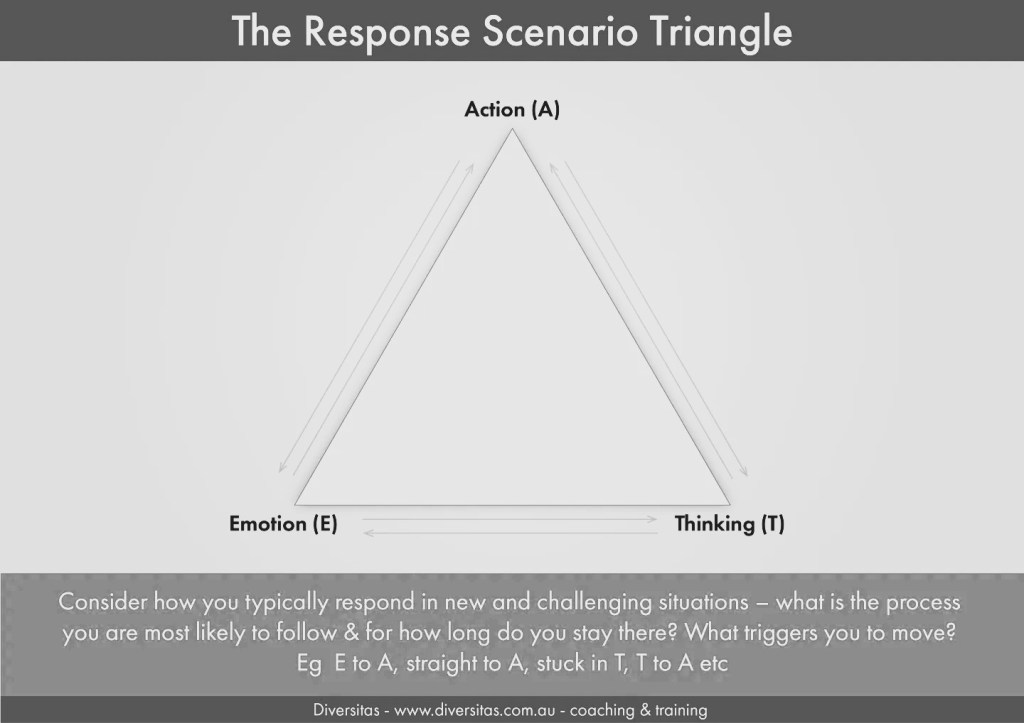
In environments defined by constant change, complexity, and constraint, executives are exposed to sustained cognitive and emotional pressure. Add uncertainty, competing priorities, and organisational politics, and even highly capable leaders can find themselves defaulting to patterns that are familiar—but not always effective.
One of the most useful and accessible frameworks I return to in executive coaching is The Response Scenario Triangle. It offers a simple yet powerful way to understand how we typically respond under stress, conflict, or change—and, importantly, where our blind spots may sit.
The model recognises three primary response modes:
- Action
- Thinking
- Emotion
Most leaders have a clear default. Under pressure, they go there first.
The value of this framework is not theoretical. It can be applied in real time—between meetings, during difficult conversations, or when decisions feel heavier than usual.
A Short Executive Reflection (5 Minutes)
When you are under pressure or experiencing sustained stress:
1. Where do you go first?
Action? Emotion? Thinking?
For example:
You may default to Action—moving quickly, stepping in, and “doing something” to regain a sense of control.
2. Why is this your default?
What does it give you in that moment?
For instance:
Action can feel productive and grounding. It may help you avoid sitting with uncertainty, ambiguity, or uncomfortable emotions.
3. How long do you tend to stay there?
And what causes you to shift to another mode?
Many executives stay in their default too long. Action-driven leaders may only move into Thinking once results stall or someone highlights what’s been missed. Emotion is often the last place they go—if at all—because it feels inefficient, uncomfortable, or risky.
What This Reveals (and Why It Matters)
As leaders reflect on their patterns, a few critical questions emerge:
- Do you over-rely on one mode and under-use the others?
- Are there phases of the triangle you consistently avoid?
- How might this shape your decision quality, communication, or leadership presence under pressure?
This framework is also valuable when making sense of others. Many leadership tensions are not about intent or competence, but about different default responses to stress—particularly within executive teams.
If you’re unsure how you show up when under pressure, ask people you trust. Their observations are often illuminating.
The Leadership Imperative
The goal is not to eliminate your default response—it exists for a reason.
The goal is to build range.
Emotionally intelligent leadership is not about feeling more; it is about integrating action, thinking, and emotional awareness so decisions are well-timed, communication is considered, and impact is sustained.
In high-stakes environments, this self-awareness becomes a leadership capability—not a “nice to have”.
Because how you respond under pressure doesn’t just affect you.
It shapes the people, systems, and outcomes around you.


Leave a Reply